
If you are thinking about moving to North Gwinnett County, places like Buford and Suwanee probably come up pretty quickly. Sitting between the two, however, is Sugar Hill, a community that can be easy to overlook if you are not already familiar with this part of Metro Atlanta.
That is changing.
Sugar Hill had an estimated population of 29,280 in 2025, up 16.8% from its 2020 population base. But the more interesting part of Sugar Hill's growth is not simply how many people are moving there. It is what the city has been building for the people who already call it home.
Sugar Hill has put a noticeable amount of effort into creating a downtown where residents can actually spend time. Instead of functioning strictly as another suburban community where you leave your neighborhood every time you want something to do, the city has created a central gathering area with restaurants, coffee, fitness, classes, entertainment, public spaces, and community events.
That changes what a normal week can look like.
You might start Saturday morning with a walk or bike ride on the Sugar Hill Greenway, stop downtown for coffee or lunch, let the kids play at the splash pad during the warmer months, and come back that evening for dinner and a concert at The Bowl. On another weekend, you could head toward nearby Lake Lanier for a day on the water.
That combination of a growing downtown, community programming, outdoor recreation, access to Lake Lanier, and a central North Gwinnett location is what makes Sugar Hill worth a closer look. It was also one of the biggest themes in the original community overview: choosing a home here is not only about bedrooms, bathrooms, and square footage. It is about what you want your normal Saturday to look like.
Key Takeaways
Sugar Hill is continuing to invest in its community. Downtown development, recreation projects, trails, public spaces, and transportation improvements are all part of the city's ongoing growth.
Downtown Sugar Hill has something for different ages and lifestyles. Families have the splash park and community events, while adults can find restaurants, bars, coffee, fitness, classes, live entertainment, and places to meet friends.
Outdoor recreation is a significant part of living here. The Sugar Hill Greenway, local parks, athletic facilities, and nearby Lake Lanier give residents plenty of ways to spend time outside.
The location makes it easy to use the rest of North Gwinnett. Sugar Hill sits between Buford and Suwanee, with shopping, dining, recreation, and major road connections surrounding the city.
Housing is more varied than you might expect. Buyers can find established subdivisions, mature neighborhoods, townhomes, newer communities, and larger single-family homes depending on where they search.
Prefer to watch instead? In this video, I take you around Sugar Hill and show you what living here actually looks like, from Downtown Sugar Hill and local events to parks, recreation, and nearby Lake Lanier.
Downtown Sugar Hill Is Built to Be Used
One of the biggest things that stands out about Sugar Hill is how much effort has gone into creating a downtown that residents can actually use.
This is not the kind of downtown where you walk around for 20 minutes, look at a few storefronts, and leave. There are several reasons to come back throughout the week.
For families with younger children, the seasonal Splash Park is tucked behind City Hall near the outdoor gathering area and The Bowl. The city notes that the park is open to the public during its operating season, although hours can vary and it may close for weather, maintenance, or concerts at The Bowl.
But downtown is not designed only around young families.
You can grab coffee, meet someone for tacos, have pizza, watch a game at a tavern, get ramen, grab dessert, or visit one of the other restaurants and businesses along West Broad Street and the surrounding downtown area. The current downtown directory includes businesses such as Rushing Trading Co., Central City Tavern, Shine Pizza, Rreal Tacos, Ramen Studio, Playa Bowls, Kilwins, and Indio Brewing.
There are also fitness options, dance and other classes, community programming, and places where you can simply walk around and spend time.
That variety is an important part of the appeal. You are not necessarily pulling into a shopping center for one specific errand and then immediately getting back into the car.
You can come downtown for one reason and end up staying for several.
The E Center Adds Another Layer to Downtown Life
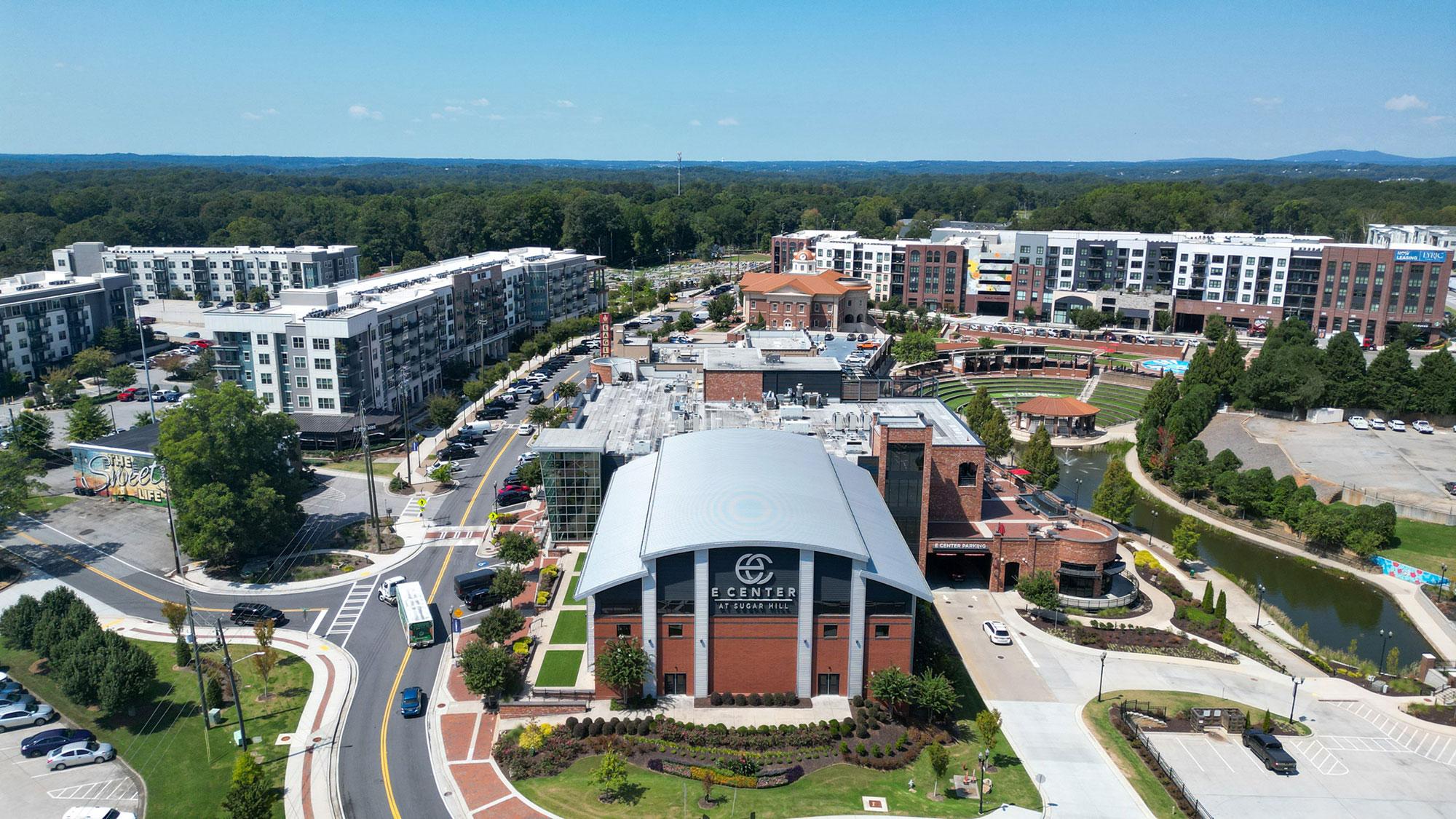
The E Center is one of downtown Sugar Hill's major community amenities.
Located in the middle of downtown, the facility includes a basketball court, an indoor padded walking and running track, cardio equipment, weights, and strength-training equipment. Sugar Hill also offers recreation programs that can include yoga, Zumba, karate, dance, and other fitness classes.
That might not sound like the first thing you would consider when choosing where to buy a home, but it matters when you think about your actual routine.
Maybe you take a class one evening during the week. Maybe you use the indoor track when the weather is bad. Maybe one person in the household is working out while someone else is grabbing coffee or meeting friends nearby.
This is what the city's investment in downtown looks like on a practical level. There are multiple reasons to use the area even when there is not a major festival or concert happening.
The Bowl and Eagle Theatre Give Sugar Hill Its Own Entertainment Options
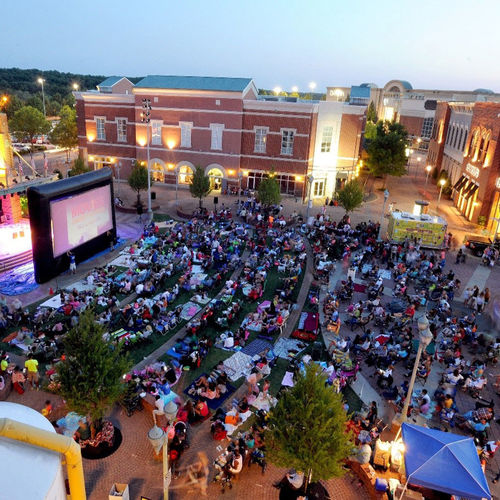
The Bowl is probably one of Sugar Hill's most recognizable downtown features.
It is an outdoor amphitheater built directly into the downtown area, with nearby restaurants and other amenities within walking distance. The venue hosts concerts and community events throughout the year.
Right nearby is the Eagle Theatre.
The 406-seat theater opened in 2018 and hosts live music, touring performances, and local community theater groups. Because of its downtown location, you can have dinner, see a performance, and spend an evening out without necessarily making the trip into Atlanta.
For a relatively compact downtown, there is a surprising amount happening in one place.
And that is really what Sugar Hill has been trying to create. The city has not simply built public spaces and hoped people use them. Downtown programming gives residents reasons to come back through concerts, classes, markets, recreation, theater, and seasonal events.
Imagine a normal Saturday.
You start with a walk in the morning. You grab coffee. If it is summer, the kids spend some time at the splash park. You head home for a few hours, then meet friends downtown for tacos or dinner. There is a concert at The Bowl that night, so you walk over afterward.
That is the part of Sugar Hill that you cannot understand by scrolling through property listings.
Outdoor Recreation Is a Big Part of the Sugar Hill Lifestyle
Downtown gets plenty of attention, but the outdoor side of Sugar Hill is just as important.
One of the biggest projects is the Sugar Hill Greenway.
The city's plan calls for a 16.5-mile system, with about five miles currently completed. The paved shared-use trail is designed for walkers, runners, bicyclists, wheelchair users, and other non-motorized users. More importantly, the long-term concept is to connect downtown with neighborhoods, schools, and parks rather than creating a trail that exists by itself.
That distinction matters.
A trail you have to drive 20 minutes to reach might be something you use occasionally. A trail that connects pieces of your community has a better chance of becoming part of your regular routine.
You can walk the dog before work, go for a run, ride bikes with the kids, or get outside for an hour without turning it into an entire day trip.
Gold Mine Park Connects Recreation With Local History
Gold Mine Park is one of the more interesting stops connected to the Greenway.
The 9.2-acre park on Level Creek Road serves as a Greenway trailhead and also highlights Sugar Hill's gold-mining history. Early settlers mined in this part of the region, and the trail system passes near one of the city's old mining locations.
That gives the park a little more character than a typical trailhead.
You are not simply getting access to the trail. You are also getting a small piece of the history behind the community.
E.E. Robinson Park Offers More Traditional Recreation
For athletic fields and more traditional park amenities, E.E. Robinson Park gives Sugar Hill residents another major recreation option.
The Gwinnett County park has two primary areas. Amenities include baseball and softball fields, pickleball courts, sand volleyball, playgrounds, tennis courts, a lighted track and multipurpose field, a paved trail, a community garden, and a splash pad.
This is especially useful for households where everyone has a different idea of what spending time outside looks like.
One person may want to run. Another may be taking a child to baseball practice. Someone else might want to play pickleball or bring younger kids to a playground.
You are not dependent on one recreation facility to do all of those things.
Lake Lanier Adds an Entirely Different Weekend Option
Then there is Lake Lanier.
Sugar Hill sits close enough to the southern part of the lake that boating, fishing, kayaking, and other lake activities can realistically become part of your weekend routine.
And you do not need to own a boat or buy waterfront property for that proximity to matter.
It simply gives you another option.
Friday evening might mean dinner and a concert downtown. Saturday could mean heading toward Lake Lanier.
Those are two very different experiences without requiring you to live in two different places.
For buyers who expect to use the lake frequently, exact location within Sugar Hill becomes more important. A home positioned toward the northern part of the area may fit your routine differently from one selected primarily for access to I-85 or downtown.
That is why a lifestyle-first home search works particularly well here.
Sugar Hill's Location Gives You More Than Sugar Hill
Another advantage of living in Sugar Hill is that you do not have to depend on Sugar Hill itself for everything.
You are positioned between Buford and Suwanee, which opens up considerably more shopping, dining, entertainment, and recreation within the surrounding North Gwinnett area.
Toward Buford, you have the Mall of Georgia area, additional shopping and restaurants, and more access toward Lake Lanier.
In the other direction, Suwanee has its own extensive Town Center, parks, restaurants, businesses, trails, and community events. Suwanee's downtown is anchored by Town Center Park and the newer Town Center on Main and DeLay Nature Park, creating a larger connected downtown environment.
That means you can enjoy Sugar Hill's smaller downtown while still using the amenities of neighboring communities whenever you want them.
Where You Live Within Sugar Hill Still Matters
This is an important point for buyers relocating from outside the area.
Sugar Hill is not one neighborhood.
Two homes can both have a Sugar Hill address while offering noticeably different daily routines.
If you expect to attend downtown events frequently, being closer to West Broad Street may matter.
If Lake Lanier is a major reason you are moving here, you might prioritize a different part of Sugar Hill.
If you commute toward Atlanta several days per week, your route toward I-85 or I-985 may matter more than being a few minutes closer to downtown.
That is why I would ask a buyer these questions before spending much time looking at houses:
Where are you commuting?
How often are you commuting?
Do you expect to use Lake Lanier regularly?
Do you want to be close to downtown events and restaurants?
How important are trails and parks?
Where will your children go to school?
What do you want a typical weekend to look like?
Once those answers are clear, finding the right part of Sugar Hill becomes much easier.
Sugar Hill Is Still Investing in Connections
The city is continuing to work on infrastructure intended to connect these pieces.
As of the city's June 2026 project update, construction had progressed on the Highway 20 pedestrian bridge, while planning continued for a downtown Greenway connection between the Peachtree Industrial Boulevard and Highway 20 area and downtown. Highway 20 widening between Buford Highway and Peachtree Industrial Boulevard was also underway, including an enhanced sidewalk intended to connect with the downtown Greenway project.
Those projects reinforce one of the larger themes of Sugar Hill.
The city is not simply adding individual amenities. It is working on connections between them.
What Are the Homes Like in Sugar Hill?
Housing is another area where Sugar Hill has more variety than people sometimes expect.
You will find established subdivisions with mature landscaping, traditional single-family neighborhoods, townhomes, newer communities, and some larger homes and lots depending on where you search.
Single-family detached houses still dominate the city's housing inventory.
Sugar Hill's ENVISION100 comprehensive plan estimates that detached single-family homes account for approximately 77% of housing. Large multifamily properties account for about 12%, townhomes about 5%, and other housing types make up the balance.
The age of the housing is also worth understanding.
More than half of Sugar Hill's housing was built during the 1990s and 2000s, a period when this part of Gwinnett County experienced substantial residential growth.
That gives buyers a substantial number of established neighborhoods that are old enough to have mature trees and developed landscaping without necessarily being what most people would consider historic housing.
Established Neighborhood or Newer Construction?
This becomes one of the bigger decisions for buyers.
An established neighborhood may give you mature trees, larger landscaping, a developed streetscape, and potentially more separation between homes.
Depending on the property, it may also mean replacing or updating older mechanical systems, roofing, windows, kitchens, bathrooms, or other components.
Newer construction gives you a different set of tradeoffs.
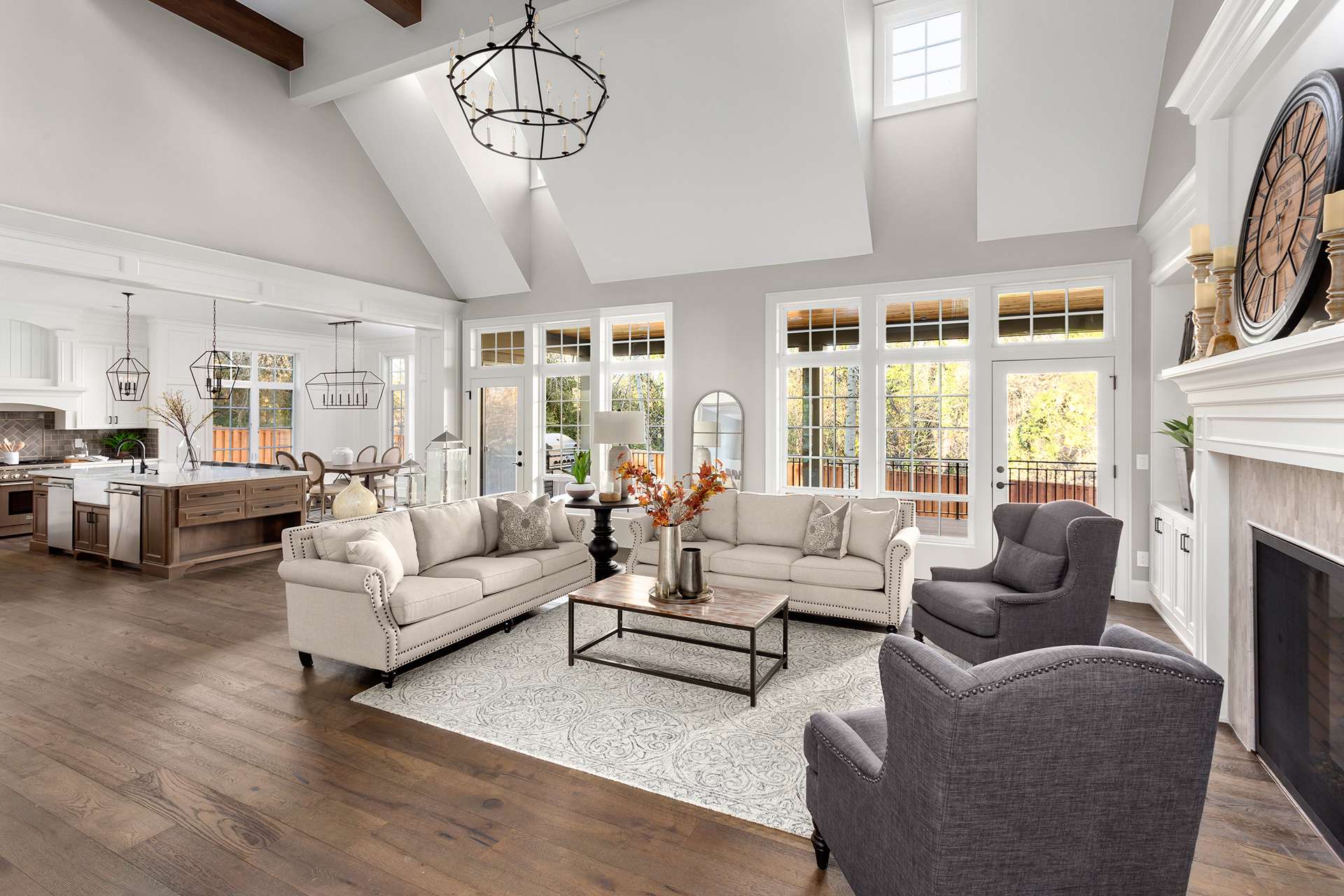
You may get contemporary floor plans, current finishes, newer systems, and less immediate maintenance. Depending on the development, you could also end up with a smaller lot, closer neighboring homes, HOA fees, or different community rules.
Neither is automatically the better choice.
The useful question is what matters more to you.
Do you want mature trees or newer systems?
Would you give up some yard space for a newer house?
Would you rather buy an older home that has already been renovated?
Do you want an HOA and neighborhood amenities?
Those answers will quickly narrow the search.
What Does It Cost to Buy a Home in Sugar Hill?
Prices depend heavily on property type, size, age, condition, neighborhood, lot, and features.
As a broad snapshot, Realtor.com's August 2026 market data reported a Sugar Hill median sold price of about $475,000 and a median listing price of about $521,875. Median time on market was 47 days.
Those figures should be treated as context, not as the price of a "typical" Sugar Hill home.
A townhome, an established three-bedroom house, newer construction, and a larger single-family home can all occupy very different price ranges.
For a buyer, the more useful approach is to establish your budget and then compare homes that actually match the type of property and location you want.
Schools in Sugar Hill
Schools are another major consideration for many households moving to North Gwinnett.
A large portion of Sugar Hill is associated with the Lanier Cluster within Gwinnett County Public Schools. The current cluster includes Sugar Hill Elementary, Sycamore Elementary, White Oak Elementary, Lanier Middle School, and Lanier High School.
Lanier Middle and Lanier High are both located in Sugar Hill.
There is an important warning here, though.
Do not assume that every property with a Sugar Hill mailing address is automatically assigned to a particular school.
GCPS enrolls students according to attendance zones, which means school assignments are property specific. Boundaries can also change over time.
If a particular school assignment is important to your home purchase, verify the exact address directly through Gwinnett County Public Schools before making a decision.
And do not stop at the school name.
Think about the daily routine that comes with it.
How long will the trip take in the morning? Will the children ride the bus? Are you crossing Highway 20 during school traffic? If you have children at multiple schools, what will drop-off and pickup actually look like?
Those questions are not nearly as exciting as touring kitchens and backyards, but they often have a bigger effect on everyday life.
How Does Sugar Hill Compare With Suwanee, Buford, and Duluth?
There is no single North Gwinnett community that makes sense for everyone.
A much better approach is to compare what each place offers with the way you want to live.
Sugar Hill vs. Suwanee
Suwanee and Sugar Hill both place a strong emphasis on gathering spaces, recreation, and community events, but their downtown environments feel different.
Suwanee has a larger Town Center environment with dining, shopping, parks, trails, public art, events, and the newer Town Center on Main and DeLay Nature Park.
Sugar Hill's downtown is more compact, with much of the experience concentrated around The Bowl, Eagle Theatre, E Center, Promenade, restaurants, classes, and nearby recreation.
If you are deciding between the two, spend a Saturday in each rather than choosing based on listing photos.
Sugar Hill vs. Buford
Buford is worth comparing if Lake Lanier access, shopping, or its independent city school system are important considerations.
The City of Buford sits along the southern shores of Lake Lanier, offers access to I-85 and I-985, and operates its own independent school system. The area also includes the Mall of Georgia and a large concentration of retail and restaurants.
Sugar Hill gives you easy access to many of those same surrounding amenities, but with its own downtown and community identity.
If spending significant time around Lake Lanier is a major priority, compare actual drive times from individual properties rather than relying on city names alone.
Sugar Hill vs. Duluth
Duluth is another useful comparison, especially if having a larger restaurant and entertainment scene matters to you.
Downtown Duluth has a significant concentration of global restaurants, cafés, shopping, public art, and year-round events around Town Green.
Sugar Hill offers restaurants and nightlife of its own, but the overall mix puts more emphasis on the combination of community programming, The Bowl, Eagle Theatre, recreation, the Greenway, and access toward Lake Lanier.
This was one of the most useful observations in the original Sugar Hill overview. If you want to understand whether Sugar Hill fits, compare it with the surrounding communities based on the lifestyle you want rather than trying to identify one "best" city.
Start With the Life You Want, Then Find the House
Before opening a home search and saving properties, picture a normal week.
Where are you driving every morning?
What do you want to do after work?
Do you want somewhere nearby to run or walk?
Will you actually use Lake Lanier?
Would you attend downtown concerts and community events?
Are you someone who likes grabbing coffee locally on Saturday morning?
Do you want a big restaurant scene, or would you rather have a smaller downtown and easy access to surrounding cities?
Would you rather live near downtown, closer to the lake, or somewhere that makes your commute easier?
Those answers are often more useful than starting with square footage.
Sugar Hill gives you several versions of suburban life depending on where you choose to live. You can be connected to downtown, prioritize recreation, position yourself closer to Lake Lanier, or choose a neighborhood primarily around your commute and housing preferences.
What makes Sugar Hill particularly interesting right now is that it is already an established community while continuing to invest in what comes next. The Greenway is expanding, downtown infrastructure continues to develop, transportation and pedestrian projects are underway, and the city continues to program the spaces it has already created.
For someone thinking about moving here, that is really the story of Sugar Hill.
It is not only a collection of subdivisions between Buford and Suwanee. It is a community that has been deliberately building places for residents to gather, exercise, eat, take classes, attend performances, spend time with their kids, and enjoy everyday life closer to home.
Frequently Asked Questions About Living in Sugar Hill, GA
1. Does Sugar Hill have city property taxes?
Yes. Properties within the City of Sugar Hill receive a city property tax bill, and property owners also receive applicable Gwinnett County and Gwinnett County Public Schools tax bills. The city's millage rate is established annually, so buyers should review the actual tax history and current rate for a property rather than estimating taxes based only on the purchase price.
When comparing two nearby homes, it is also worth verifying whether both properties are actually inside the Sugar Hill city limits.
2. How can I confirm that a house is actually inside Sugar Hill?
Do not rely entirely on a mailing address.
Municipal boundaries and postal addresses are not always the same thing, so if city services, taxes, or regulations matter to you, verify the property's jurisdiction before purchasing.
This becomes especially important when comparing homes near city boundaries.
3. Does Sugar Hill operate any of its own utilities?
Yes. The City of Sugar Hill operates its own natural gas utility serving residents and businesses within its service territory.
Utility providers can vary by property, however, so buyers should confirm electric, water, sewer, trash, gas, and internet providers for the specific address they are considering.
4. Can you drive a golf cart around Sugar Hill?
Sugar Hill has adopted local rules allowing registered motorized carts on certain roads under specific conditions. The details involve registration, equipment, insurance, driver requirements, and where carts may legally operate.
Because routes and regulations can change, anyone purchasing a home specifically because they want golf-cart access to downtown should verify the current city ordinance and approved road network before buying.
5. What is the best way to decide whether Sugar Hill is right for me?
Spend time here when you are not touring houses.
Come downtown on a Saturday morning. Grab coffee or lunch. Walk part of the Greenway. Drive from the neighborhoods you are considering to Lake Lanier, the grocery store, schools, or your workplace.
Then come back during a weekday commute.
If possible, attend a downtown event or concert so you can see what the area feels like when residents are actually using it.
A home can check every box on paper and still be in the wrong location for your routine. Sugar Hill has enough variety that the better strategy is to figure out how you want to live first, then find the neighborhood and house that support it.
Check out this article next